
Bathroom Ceiling Leak Singapore: Who Is Responsible in HDB & Condos?
- waterseepagesg
- Jul 8
- 6 min read
Seepage Solutions provides bathroom and toilet leak repair services in Singapore for water seepage caused by waterproofing defects, concrete cracks, pipe penetrations and concealed leakage.
A bathroom ceiling leak is a common water seepage problem in Singapore HDB flats and condominiums.
The first signs may be a yellow or brown ceiling stain, peeling paint, bubbling plaster, mould growth or water dripping from the bathroom ceiling.
For many homeowners, the immediate question is:
Is the leak coming from my bathroom or the unit above?
And more importantly:
Who is responsible for repairing the water leakage?
The answer depends on the source of the leak and whether the property is an HDB flat or condominium.
Before repair works are carried out, the likely source of the water seepage should first be identified.
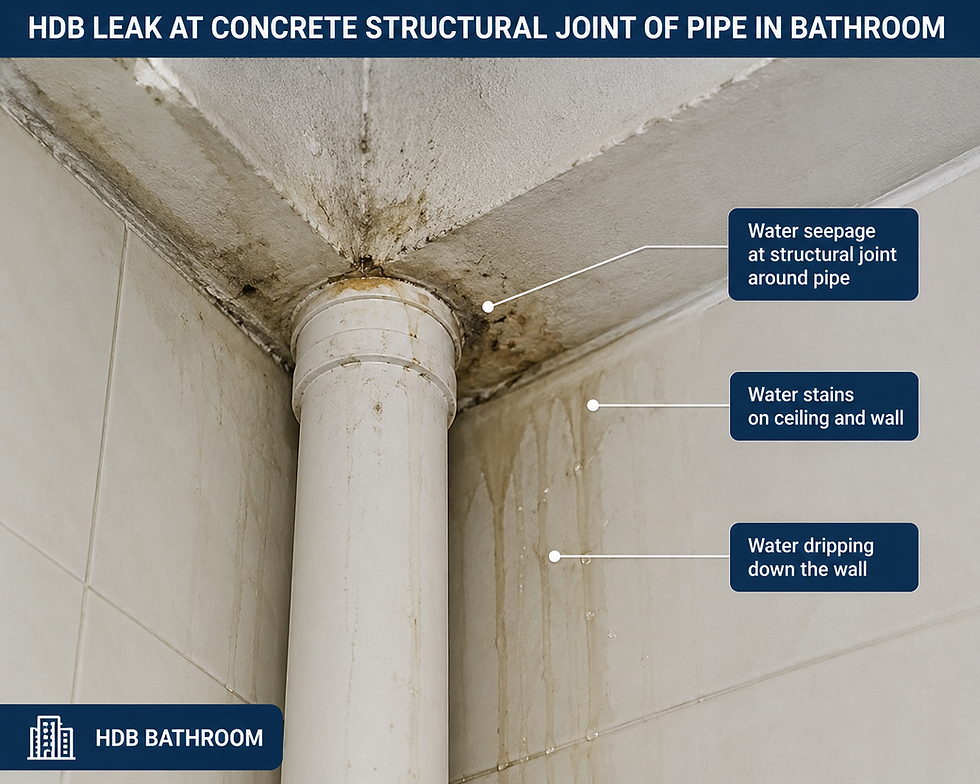
Why Is My Bathroom Ceiling Leaking?
Water appearing on a bathroom ceiling does not always mean the leak started directly above the visible stain.
Water can travel through concrete slabs, cracks, construction joints and pipe penetrations before appearing at another location.
Common causes of bathroom ceiling leakage include:
Failed bathroom waterproofing
Cracks in the concrete floor slab
Defective tile joints or grout
Leaking water supply pipes
Leaking sanitary or drainage pipes
Floor trap leakage
Pipe penetration defects
Shower waterproofing failure
Water seepage through concrete joints
This is why repainting a stained bathroom ceiling rarely solves an active water leakage problem.
The source of the water should first be identified before deciding whether a plumber, waterproofing specialist or other contractor is required.
Who Repairs a Bathroom Leak in Singapore?
The correct contractor depends on the cause of the bathroom leak.
A leaking water pipe, tap or sanitary fitting may require a plumber.
However, water seepage caused by failed waterproofing, concrete cracks, construction joints or pipe penetrations may require a waterproofing and leak repair specialist.
Seepage Solutions provides bathroom and toilet leak repair services in Singapore for water seepage caused by waterproofing defects, concrete cracks, pipe penetrations and concealed leakage.
Depending on the source of the leak, repair methods may include PU injection, targeted waterproofing repair, crack sealing, pipe penetration sealing or leak detection.
The aim of an initial assessment is to identify the likely source before recommending repair works.
HDB Bathroom Ceiling Leak: Who Is Responsible?
According to Housing & Development Board’s guidance on preventing and fixing ceiling leaks in HDB flats, inter-floor ceiling leaks may require cooperation between the upper and lower flat owners.
For ceiling leakage between an upper and lower HDB flat, the floor slab separating the two units is considered a shared structure.
According to HDB’s guidance on ceiling leaks, flat owners are responsible for maintaining their flats.
For eligible ceiling leak repairs under HDB’s Goodwill Repair Assistance scheme, HDB may co-pay 50% of the repair cost, with the remaining 50% shared equally between the upper and lower flat owners.
In practical terms, both the upper-floor and lower-floor HDB owners may need to cooperate when investigating and repairing an inter-floor ceiling leak.
What If My HDB Bathroom Is Leaking Into the Flat Below?
If water from your bathroom is seeping into the ceiling of the flat below, the leak should be investigated promptly.
Possible causes include:
Failed toilet waterproofing
Cracks in the floor slab
Leakage around floor traps
Pipe penetration defects
Leaking concealed pipes
Defective joints
Shower area leakage
Depending on the cause, a full bathroom renovation or complete hacking of the toilet may not always be necessary.
Targeted repair methods may be possible where the water source can be reasonably identified.
These may include PU injection, crack repair, pipe penetration sealing or targeted waterproofing works.
What If the HDB Leak Comes From Common Property?
Not every water leakage problem between HDB flats originates from a private unit.
If the water is suspected to originate from common property or shared building infrastructure, the relevant Town Council may need to investigate.
For example, responsibility may differ where leakage is related to a main sanitary pipe or another component maintained as common property. Identifying the source of the leak is therefore important before appointing a contractor or assigning responsibility.
Condo Bathroom Ceiling Leak: Is the Upstairs Owner Responsible?
Building and Construction Authority’s strata management guidance on water seepage explains the responsibilities and repair approach for water seepage in strata developments.
The situation is different for condominiums and other strata-titled properties in Singapore.
For inter-floor water leakage in a strata development, the leak is generally presumed to originate from the upper-floor unit unless the upper-floor owner or occupier can prove otherwise.
However, this does not mean every ceiling stain is automatically the fault of the upstairs neighbour.
The water may originate from:
Common property
Shared building services
Common pipes
External walls
Roof areas
Another concealed source of water
An investigation may therefore be required to determine whether the leakage originates from the upper unit or another part of the development.

What Should a Condo Owner Do About a Bathroom Ceiling Leak?
If you notice water seepage from your condominium bathroom ceiling, inform the MCST or managing agent and the owner or occupier of the unit above.
Photograph the affected ceiling and record when the leakage occurs.
Useful observations may include whether the leak:
Becomes worse after shower use
Appears after the bathroom above is used
Occurs continuously
Appears during heavy rain
Stops for several days and returns
These patterns can provide useful clues about the possible water source.
Where necessary, a water leakage assessment or leak investigation should be carried out before repair works begin.
Is the MCST Responsible for a Bathroom Ceiling Leak?
It depends on the source of the water leakage.
If the leak originates from a defect within a private strata unit, responsibility may rest with the relevant unit owner.
If the water originates from common property or shared building infrastructure, the MCST may need to investigate and arrange the necessary repair works.
The source of the leak should therefore be established before responsibility is assigned.
This is particularly important for concealed leaks where the visible ceiling damage may be some distance from the actual source of water entry.
Can a Bathroom Ceiling Leak Be Repaired Without Hacking?
In some cases, yes.
A bathroom ceiling leak does not automatically mean the entire toilet floor must be hacked and renovated.
The correct repair method depends on the source and pathway of the water leakage.
PU Injection
Polyurethane resin may be injected into cracks or voids in concrete to seal water pathways.
PU injection may be suitable for certain concrete seepage defects but is not the correct solution for every bathroom leak.
Targeted Waterproofing Repair
Where a defective waterproofing area can be identified, targeted waterproofing repair may be considered.
The suitability of this method depends on the condition and location of the existing waterproofing system.
Pipe Penetration Sealing
Openings and defects around pipes passing through the floor slab can sometimes allow water to seep into the unit below.
These areas may require sealing or waterproofing repair.
Crack and Joint Repair
Cracks in concrete or defective construction joints may create pathways for water.
Depending on the condition of the affected area, crack sealing or PU injection may be recommended.
Plumbing Repair
If the leak originates from a water supply pipe, sanitary pipe or plumbing fitting, the defective plumbing component should be repaired.
A waterproofing treatment will not solve an active leaking pipe.
PU Injection or Waterproofing: Which Is Better for a Bathroom Leak?
Neither method is automatically better.
The correct solution depends on why the bathroom is leaking.
PU injection is commonly used to seal water pathways through cracks and voids in concrete.
Waterproofing repair may be more appropriate where the existing waterproofing system has failed.
If the source is a leaking pipe, plumbing repair is required instead.
This is why Seepage Solutions assesses the likely leak source and water pathway before recommending PU injection or waterproofing repair.
Applying the wrong repair method may temporarily hide the visible symptoms without addressing the actual cause.
Should I Repair the Bathroom Ceiling or the Leak First?
The source of the water leakage should be repaired first.
Painting over water stains, replacing damaged plaster or applying anti-mould paint does not stop active water seepage.
If moisture continues entering the ceiling or concrete slab, the staining and peeling paint may return.
The typical repair sequence is:
Identify the likely source of the water
Repair the waterproofing, concrete defect or leaking pipe
Allow the affected area to dry
Monitor the ceiling for recurring seepage
Reinstate damaged ceiling finishes
This reduces the risk of repeatedly repairing the same ceiling damage.
Signs Your Bathroom Ceiling Leak Should Be Investigated
A bathroom ceiling leak should be investigated if you notice:
Persistent yellow or brown ceiling stains
Damp patches
Bubbling paint
Peeling plaster
Mould or mildew growth
Water dripping from the ceiling
Recurring damage after repainting
Rust stains
Cracking or bulging concrete
Persistent moisture can damage ceiling finishes and may contribute to deterioration of the affected concrete.
If concrete begins cracking, bulging or falling from the ceiling, the area should be assessed for possible spalling concrete.
Bathroom Ceiling Leak Assessment and Repair in Singapore
If you are experiencing a bathroom ceiling leak in an HDB flat or condominium, the first step is to identify the likely source of the water seepage.
Seepage Solutions provides bathroom leak assessment, toilet leak repair and waterproofing services in Singapore.
Depending on the cause of the leakage, recommended solutions may include:
PU injection and PU grouting
Bathroom waterproofing repair
Crack sealing
Pipe penetration sealing
Leak detection and moisture assessment
Plumbing leak identification
Ceiling reinstatement works
Every leak is assessed based on the affected area and likely water source before a repair method is recommended.
Unsure whether the leak is from your bathroom or the unit above?
Contact Seepage Solutions for a water leakage assessment and recommended repair solution.
Last Updated: 8 July 2026


Comments