
Mould or Water Leak? How to Tell the Difference | Singapore Homeowner Guide
Updated: Jun 26
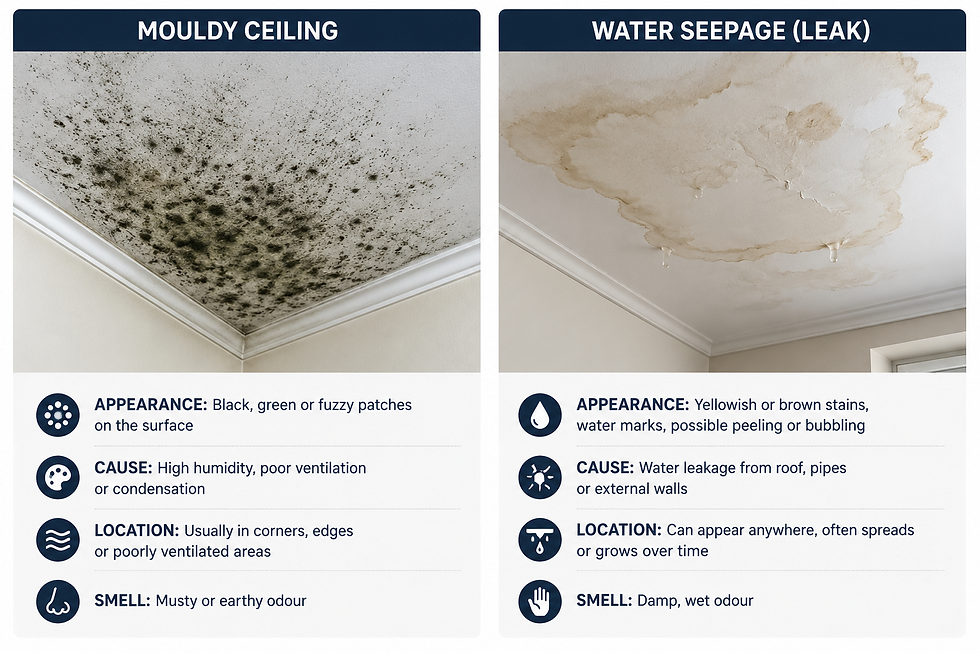
Why Homeowners Often Confuse Mould and Water Leaks
Dark patches on walls, peeling paint and musty smells often leave homeowners wondering whether they have a mould problem or a leaking wall. Although mould and water seepage are closely related, they are not the same issue. Mould is usually the result of excessive moisture, while water seepage is the underlying cause in many Singapore homes.
Understanding the difference helps prevent unnecessary mould cleaning when the real issue is hidden water intrusion.
Mould and water leak are related issues but distinct in their nature and effects.
Here are the key differences between them:
Water Leaks | Mould Growth |
Caused by water intrusion or plumbing failure | Caused by excess moisture and dampness |
Often appears as wet patches, stains, or dripping water | Appears as dark spots or fuzzy patches |
Can damage structures and paintwork | Can spread across damp surfaces |
Usually the source of the moisture problem | Often a symptom of an underlying moisture issue |
Requires leak detection and waterproofing repairs | Requires moisture removal and proper treatment |
Why Does Mould Keep Coming Back?
Mould requires three things to grow:
Moisture
Warm temperatures
Organic material such as paint, plasterboard or timber
When water continuously enters a wall through cracks or leaking waterproofing systems, mould can quickly spread behind paint and finishes.
Unless the moisture source is eliminated, mould will usually return.
Common Causes of Mould in Singapore Homes
Hidden Water Seepage
One of the most common causes.
Water enters through cracked concrete, failed waterproofing membranes or construction joints.
Roof Leaks
Rainwater can travel through roof slabs before appearing on ceilings or upper-floor walls.
Bathroom Waterproofing Failure
Water escaping from shower areas can migrate into adjacent rooms and cause mould.
External Wall Cracks
Rainwater penetrates exterior walls and keeps internal surfaces damp.
Plumbing Leaks
Leaking pipes inside walls often create localised mould growth.
Condensation
Poor ventilation around air-conditioning units or bathrooms can also encourage mould.
Signs the Mould Is Caused by Water Leakage
You may notice:
Bubbling paint
Peeling paint
Damp patches
Water stains
Soft plaster
White powder (efflorescence)
Musty smell
Mould returning after cleaning
These signs usually indicate ongoing moisture rather than surface contamination.
Is Mould Dangerous?
Prolonged mould exposure may contribute to:
Allergies
Asthma symptoms
Eye irritation
Skin irritation
Respiratory discomfort
Unpleasant indoor odours
Young children, elderly individuals and people with respiratory conditions may be more sensitive.
How We Stop Water Seepage
Depending on the cause of the leak, repairs may include:
PU injection (PU grouting)
Roof waterproofing
External wall waterproofing
Balcony waterproofing
Bathroom waterproofing
Pipe penetration waterproofing
Crack sealing
Every repair starts with identifying where the water is entering.
Can You Simply Paint Over Mould?
No.
Anti-mould paint can improve the appearance temporarily, but if the wall remains damp, mould is likely to return.
The underlying moisture problem must be resolved first.
Preventing Mould in Singapore Homes
Homeowners can reduce mould by:
Repairing leaks promptly
Improving ventilation
Using exhaust fans
Keeping bathrooms dry
Inspecting external wall cracks
Maintaining roof waterproofing
Scheduling professional leak inspections when mould repeatedly returns
Request a Professional Leak Inspection
If mould keeps returning despite repeated cleaning or repainting, the problem is likely hidden moisture rather than surface contamination.
Contact Seepage Solutions for a professional inspection to identify the source of the leak and recommend the most effective waterproofing solution.
FAQs
How do I know if mould is caused by a water leak?Persistent damp patches, peeling paint, musty smells, and recurring mould may indicate a hidden leak.
Can mould grow without a water leak?Yes. Poor ventilation and high humidity can also cause mould growth.
Is mould dangerous to health?Mould may trigger allergies, respiratory irritation, and unpleasant indoor air quality.
Will cleaning mould solve the problem permanently?No. The source of moisture or leakage must be identified and rectified first.
How can leaks behind walls be detected?Thermal imaging and moisture inspection tools help detect hidden water seepage without hacking.
Do you provide mould and leak inspections in Singapore?Yes. We provide leak detection and waterproofing solutions for HDB, condo, landed and commercial properties across Singapore.


Comments